
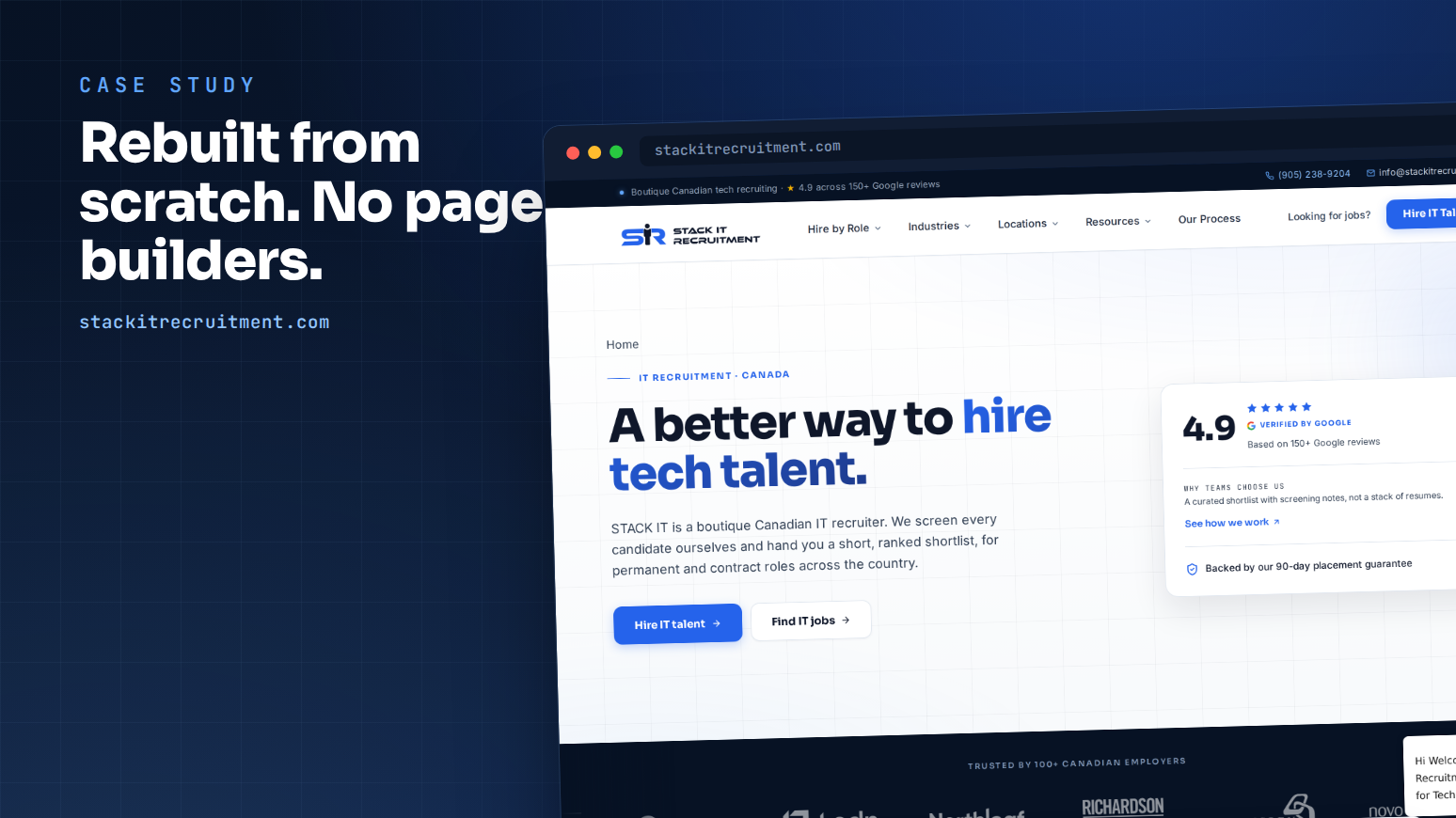
Most recruiting websites are the same site wearing different logos. A stock hero photo of people shaking hands, three paragraphs about “top talent,” a contact form, done. When STACK IT Recruitment came to us for a rebuild, the brief was blunt: they compete with firms fifty times their size, and the website had to work harder than headcount ever could.
STACK IT is a boutique Canadian IT recruiting firm with offices in Mississauga, Toronto, and Ottawa. They place software engineers, DevOps leads, data teams, and everything in between, and they hold a 4.9 rating across more than 150 Google reviews. The reputation was already elite. The website was the weakest thing about the company. So we replaced it. All of it.
No page builders. We meant it.
The foundation decision shaped everything else: a fully hand-coded custom WordPress theme. No Elementor, no Divi, no drag-and-drop layer adding half a megabyte of scripts to every page. Every template on the site is purpose-built PHP, every stylesheet is written by hand, and every component exists because a page needed it.
That choice pays rent daily. Pages load fast because there is nothing to load except the page. The design system stays consistent because it lives in one place instead of a thousand builder settings. And when STACK IT needs a new page type, we build it once and it works everywhere.
The visual system got the same treatment: a custom design language built on Sora, Inter, and JetBrains Mono, a deep navy and electric blue palette, and a component library covering everything from the mega menu to the review cards. It looks like a technology company because their clients are technology companies.
A landing system, not a landing page
Under the hood, the site is a content architecture with around 140 purpose-built URLs. Twenty-eight role pages, one for every position STACK IT recruits, each with its own screening breakdown, salary context, and FAQ schema. Twenty-one Ontario location pages. Six industry pages. Five content pillars driving the blog. Each template pulls from structured data, so a new role or city launches in minutes and arrives complete: schema, breadcrumbs, internal links, the lot.
The jobs board is live infrastructure rather than a static list. It pulls open roles directly from STACK IT’s applicant tracking system, generates Google-compliant JobPosting structured data with parsed salary ranges, publishes to its own XML sitemap, and pings search engines through IndexNow the moment a role changes. When a position closes, the page redirects intelligently instead of rotting as a 404.
Tools people actually use
The part we are proudest of is the tools hub. Instead of another gated PDF farm, STACK IT’s site now runs working interactive tools in the browser: a weighted technical interview scorecard built from their real screening process, an Ontario Bill 190 job-posting compliance builder with a live pass-fail meter, a salary benchmarking dashboard covering the Canadian tech market, and a vacancy cost calculator that prices an empty technical seat by role.
These earn links, rankings, and trust because they are genuinely useful before anyone fills in a form. That is the whole strategy in one sentence.
The invisible layer
Search infrastructure got the same custom treatment as the design. Structured data flows through a single schema graph: organization, offices with per-location Google review ratings, services, FAQs, breadcrumbs, job postings. Local SEO covers all three offices. The blog runs on a pillar system where every post strengthens a cluster instead of floating alone.
None of this is visible to a visitor. All of it is visible to a search engine, which is rather the point.
The result
Visit STACK IT Recruitment and click around. The site loads instantly, reads clearly, and does things recruiting websites do not normally do. Try the interactive hiring tools and you will see what we mean about working in the browser.
For STACK IT, the website went from the weakest part of the company to a fair reflection of a firm that outperforms its size. For us, it is proof of an argument we have been making for years: custom beats template, and the gap shows up everywhere from load times to lead quality.
Thinking about whether your own site is holding you back? That conversation is free.